
DDfV EdSig Workshop: Student Responsibility and Value Awareness through Portfolios
EdSIG core member Pim van der Male (ME) organized a workshop on his experience with student portfolios in the MSc Offshore & Dredging Engineering. Pim asks students to answer reflective questions throughout the first year of their programme. These questions relate explicitly to some final attainments of the programme and by their reflections, students can demonstrate their development on these aspects. Some questions explicitly invite students to reflect on important values in their domain and on their personal core values. The overall intention of the reflection exercise is to make students more aware of their personal growth and encourage them to take responsibility for their personal development.
Values in Student Portfolios
At the start of the workshop, participants were invited to think of important non-technical qualities that we want to see in TU Delft Graduates. Most mentioned quality was ‘empathy’. Other examples of mentioned qualities were ‘curiosity’ and ‘autonomy’. The idea was that this question directed the minds of the participants towards qualities that we value most in our graduates.
After this ice-breaker, the topic of values was discussed in more depth. What are values (in general) and what are the core values of TU Delft?
| During the workshop, values were understood as moral and social principles – such as justice, autonomy, sustainability, and privacy – that express what is considered important or desirable, and that should guide and be embodied in technological design |
The concept of values was then linked to the experience with individual reflection portfolios in the master programme Offshore & Dredging Engineering. During the first year of this programme, Self-Development, Scientific Communication, Collaborative Problem-Solving and Ethical Intelligence have been developed as horizontal learning lines that run along technical courses. These learning lines are assessed by means of an individual reflection portfolio.
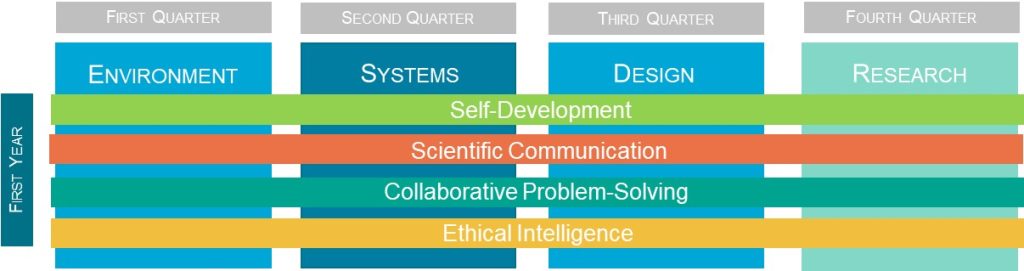
In their portfolios, students answer four reflective questions per quarter, each relating to one learning line. Their answers should be based on their experiences in the courses of that quarter, even though sometimes students also reflect on earlier phases of their studies, or events in their personal life. The template of the portfolio contains links to video material and suggestions for further reading, so students have sufficient material to use in their reflections.
| Portfolios provide a structured way for students to demonstrate their growth and development over time – both in technical and non-technical domains – through curated evidence, reflection and authentic artefacts from their learning process |
At the end of both semesters, all students are invited for a reflective interview with the lecturer of the course. This interview serves to deepen some reflections and to guide students towards the next phase of their studies. After submission of a complete portfolio, and a successful interview, the work of the students is graded as ‘pass’ of ‘fail’, the latter giving the student the opportunity to elaborate further on the submitted reflections. When reviewing the submitted assignments, it is observed that although students give importance to values beyond the technical domain, such as fairness, they often do not recognize how these values relate to what they learn in their program, as illustrated by the examples below.
Some examples
In the first quarter, students are asked to reflect in the societal and environmental impacts of their engineering work. Many students mention some of the several well-known impacts of their domain. Perhaps more interesting statements refer to the way they did or did not identify these impacts in their courses. Some students mention that they ere not concerned with these impacts and/or that it is the responsibility of lecturers to make them aware of such impacts. Other students indicate that they did learn about the relevance of societal and environmental impacts during their courses.
| “If I am working on a subject I am more interested in how everything within the theory works and then I am not that concerned about what that implies in the real world. But when I reflect I do think that it is critical to have the professors zoom out and talk about the real world implications of what we’re doing. Because this is a field which has a big influence on the environment and the society.” “To connect this to a course I followed or something from the […] master is a bit hard I think, because all the courses were mainly focussed on programming and not really something for society or the environment.” “[…] it became clear to me how many stakeholders influence such a large project. To be honest, I did not expect beforehand that so many parties would be involved.“ |
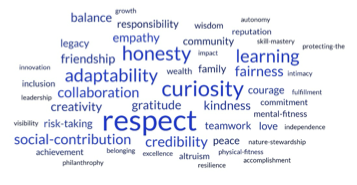
A second example concerns the personal values that were identified by the students though a simple online test. Students were asked to reflect on their top-5 personal values as a student and future engineer. During the work shop, a word cloud was presented, that highlights the most common values of the group of students. This work cloud was also communicated towards the students after the reflective exercise, and students were invited to demonstrated these values in their future course work.
Discussion
The workshop touched upon three layers of values (institutional, domain specific and personal) and the last part of the workshop was dedicated to a discussion on each of these domains. The participants were divided into three groups and each of those addressed one of the layers by trying to answer a question for further development.
How can we make institutional core values concrete, relevant and actionable in our courses?
We should make the institutional core values explicit in the external communication toward prospective students. Lectures can then reference to this and we can encourage lecturers to incorporate (some of) these values in their courses. Of course, there should be support for this. It is very important that lecturers and other TU Delft staff – and in fact all employees of TU Delft – act as role models towards students. We give the right example. For students it could be very valuable if we connect the core values of TU Delft to their dreams: Why are we doing this?
What teaching practices help students take responsibility for the societal and environmental consequences of their engineering work?
We should integrate ethics in across courses and course subjects, instead of offering it as a separate course. Of course, we should make our students familiar with the relevant ethical theories in moral decision making and then we can have them assess case studies, where we should both consider positive and negative examples. It would be great if we could connect our students with societal groups in some courses, and otherwise, we can introduce role plays. For certain case studies, we can discuss criteria for success and simulate different outcomes based on different values for the same situation. We could easily adopt this in our project courses.
What teaching practices help students take responsibility for the societal and environmental consequences of their engineering work?
We should integrate ethics in across courses and course subjects, instead of offering it as a separate course. Of course, we should make our students familiar with the relevant ethical theories in moral decision making and then we can have them assess case studies, where we should both consider positive and negative examples. It would be great if we could connect our students with societal groups in some courses, and otherwise, we can introduce role plays. For certain case studies, we can discuss criteria for success and simulate different outcomes based on different values for the same situation. We could easily adopt this in our project courses.
Important Takeaways for Student Portfolios
The discussions during the workshop resulted in some important insights that can strengthen student responsibility and value awareness:
- TU Delft’s core values can be introduced and discussed at the start of the educational programme. Students can be invited to reflect on (some of) these values in their reflection portfolio.
- Domain-specific values should be addressed explicitly in the technical courses of the programme. Students should be given the freedom to identify domain-specific values in their projects and should demonstrate how they considered these values in their designs.
- Personal values can serve as building blocks in collaborative settings. Students can be asked to reflect collectively on the most important values of the different team members and draft a code of conduct for their project work.
Participants
The workshop was attended by 17 active participants, consisting of educators from different faculties (CEG, EEMCS, ME, TPM) and learning developers from EEMCS and ME.
Related posts
 May 26
Education Special Interest Group: Design for Values in Education at TU Delft
The Education SIG aims to bring together educators from across the TU Delft to strengthen the integration of values, such as sustainability,…