
TPM Energy Transition Lab Seminars Navigating Normative Challenges: Stakeholder Engagement and Methodologies

Addressing the complex challenges of global energy transitions requires interdisciplinary perspectives, collaborative research, and critical reflection on policy implications. Effective stakeholder engagement is essential to ensure that research projects are socially relevant, empirically grounded, and impactful. However, researchers often face significant challenges in selecting and applying appropriate methodologies for stakeholder engagement. Moreover, guidance is limited on how to navigate conflicting stakeholder priorities, power imbalances, and other complexities that arise in this context.
This seminar series seeks to identify and examine these bottlenecks while exploring methodological approaches and practical solutions for stakeholder engagement in the context of global energy transitions. The series aims to facilitate knowledge sharing within the TPM faculty and beyond, creating a space for participants to present case studies and reflect on personal experiences with stakeholder engagement. Together, we will discuss various strategies for navigating stakeholder engagement challenges and reflect on methodological tools for exploring the global energy transition. The format is open-ended and experimental.
If you would like to present or if you’d like the TPM Energy Transition Lab to connect with your research community that researches global energy transitions, please contact a.melnyk@tudelft.nl.
We look forward to seeing you there!
Seminar 1: Decolonial Justice and the Global Energy Transition: Reflections with Envisioning Cards
TPM ET Lab × Delft Design for Values Institute
Date: 14 May 2025 (16:00–17:30), TPM-Hall H, 31.A1.210
Presenters:
Anna Melnyk (TU Delft)
Ángela María Díaz (Universidad de las Américas)
Description:
This seminar explores the role of decolonial justice in global energy transitions from academic, engineering, and Indigenous activist perspectives. We highlight Design for Values as a framework for developing technologies that support more transparent, inclusive, and equitable transitions. Despite its potential, current practices often overlook decolonial justice—a concept that encourages engineers and practitioners to critically examine their roles in relation to environmental and community impacts, especially among historically marginalized groups. We define decolonial justice as an active form of justice that addresses systemic oppressions such as land grabbing, cultural appropriation, marginalization, and exploitation—issues deeply intertwined with global energy transitions. In this session, participants will translate reflection into action through an interactive game prototype developed by the decolonial group at TU Delft and collaborators. The game investigates how privilege, power, and responsibility—shaped by both social and professional identities—influence our relationships and obligations toward people and the environment.
Key questions we will explore include:
- How do dominant perspectives shape energy policies and technological choices?
- How do justice concerns—particularly those rooted in colonial histories—emerge in engineering and policy contexts?
- What barriers hinder the inclusion of Indigenous and marginalized community perspectives in energy decision-making?
- What strategies can help integrate these perspectives into mainstream approaches?
- How can individual contributions promote more just and sustainable energy futures?
We invite academics, practitioners, and interested individuals to join us for this interactive and thought-provoking session.
Seminar 2: Navigating Stakeholder Engagement Bottlenecks in Policy Contexts
TPM ET Lab × Empirical Philosophy Cluster
Date: 12 June 2025 (10:00–11:30), TPM-Hall D, 31.A0.250 (hybrid)
Presenters:
Udo Pesch (TU Delft)
Anna Melnyk (TU Delft)
Description:
The expansion of offshore wind energy in the Netherlands is a critical development in the push toward net-zero emissions. While this transition supports climate goals, it also raises complex ethical questions related to ecological sustainability, spatial planning, and stakeholder inclusion. Researchers from TU Delft—including Behnam Taebi, Andrea Gammon, and James Hutton—along with the TPM Energy Transition Lab (Udo Pesch and Anna Melnyk), conducted a project mapping the values and ethical dilemmas associated with offshore wind development in the North Sea. The project applied the Design for Sustainability approach to explore socio-technical and ecological trade-offs. This seminar will present key insights from the project, with a focus on the role of stakeholder engagement in shaping policy-relevant research. We will discuss how to navigate normative uncertainties and ensure that diverse perspectives inform energy policy decisions. The session will also emphasize the importance—and challenges—of collaboration among industry, government, academia, and environmental organizations.
Join us in this critical discussion and help explore new pathways for navigating stakeholder engagement challenges in the energy transition.
Related posts
 Dec 28
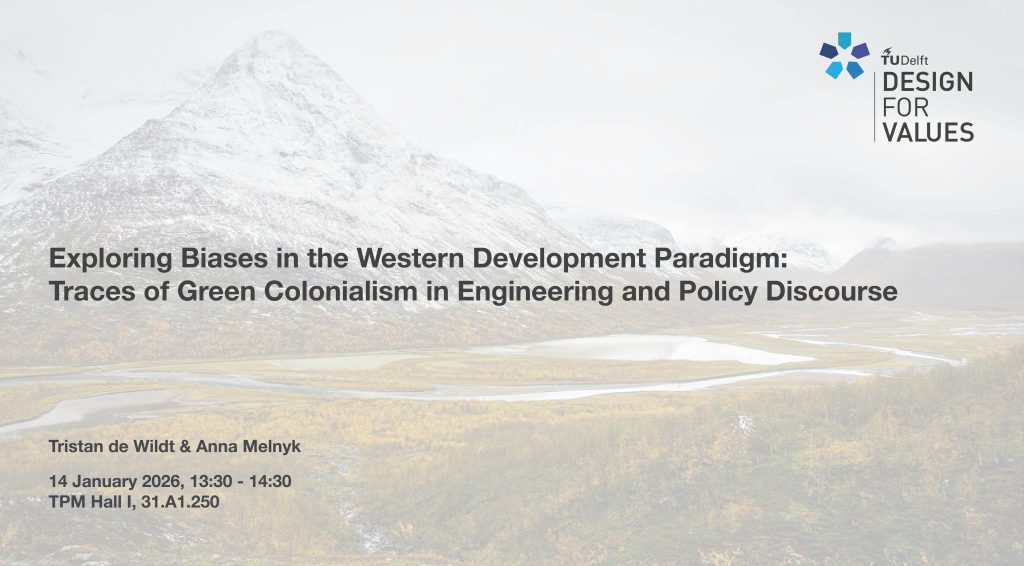
SIG Talks: Design for Justice – Exploring Biases in Green Colonialism in Engineering and Policy Discourse
About the SIG Talk As part of the Design for Justice Special Interest Group (SIG) of the Delft Design for Values Institute…
 May 23
Workshop: The Right Against Manipulation (19 June)
Link to event
 May 11
Join the Energy Justice Festival – JustETrans on May 16th!
The energy transition affects everyone. It is therefore important to make decisions that help to achieve climate goals in a fair way.…