
Diversity, Equity and Inclusion in Design Education (INDEED)

A blog by Rebecca Baugh, Rachel Lee and Roberto Rocco.
Diversity, equity and inclusion are becoming increasingly significant issues within the TU Delft’s community of students and academic and non-academic staff. Bolstered by the Black Lives Matter movement, as well as the #metoo campaign, students have voiced their concerns through media productions, discussion events and their own academic work. University staff are also addressing these issues in their teaching and research work, and bottom-up initiatives. And at senior management level, TU Delft is currently instituting Diversity Officers in every faculty and has already installed a university-wide Diversity Officer.
Despite these positive moves, a number of colleagues and students still fail to recognise why valuing diversity, equity and inclusion is important, or even relevant, at a university of technology. Building on a meritocratic backbone, the university’s core values, such as scientific objectivity, neutrality and a “can do” attitude, are argued to trump identity concerns. So why does diversity matter?
At a recent community meeting, the Delft Design for Values Institute invited students and staff from across the campus to discuss the importance of these values, with the intention of developing an action plan that can be implemented within the university.
Through an interactive intervention led by Rebecca Baugh (Master’s student ABE) and Simone Uriartt (Master’s student IDE), the meeting participants were asked to reflect on their own positionalities, recognising potential intersections of privilege and oppression/marginalisation. They were then prompted to consider how these could be inflecting their opportunities and generating biases. If factors including race, gender, class, sexuality, language, body type and education affect people’s chances in life and direct the ways in which we interact, what can a university do to produce a more equitable and inclusive research and learning environment?
“Do we try to be universalists or do we embrace that we are all different? Do we try to find one solution that fits all, or do we look for multiple solutions that embrace all differences?” Simone asked.
source: created by Simone Uriartt
Besides the issues of well-being, representation and justice, there is an issue of epistemic plurality to be addressed. In communicative theory, knowledge formation relies upon the contributions of a wide variety of people with different life experiences and a diversity of perspectives. One-sided knowledge production has led to knowledge that is biased or blind to the needs of certain groups. One of the most salient examples is the Modernist movement in architecture and urbanism, which was an essentially Western-European, white, male movement, which largely failed to incorporate alternative views on how buildings and cities could be planned and designed. Modernism in architecture and urbanism was often “translated” to local contexts later on, but the single perspective persisted. Likewise, all knowledge can benefit from inputs from a multitude of perspectives to be robust, unbiased, resilient and sustainable.
Before getting down to addressing the whats and hows, Rebecca encouraged everyone to consider why we build knowledge and why diversity should be constitutional to its development. Thinking with examples including the effects of apartheid on the accessibilty of knowledge and the impact of imposed knowledge systems in Latin America, the group began framing diversity as crucial in expanding current knowledge paradigms, rendering it more democratic, reflective and representative of the world we share.
Want to join in on this conversation and initiative? Contact Rachel Lee…
W2R2bWVtYmVyIGlkPSI4MTIzIiBncmlkc3R5bGU9ImZ1bGwiIG9mZnNldD0iMjAiIGl0ZW13aWR0aD0iMjUwIiBzaWRlPSJyaWdodCIgcm91bmRlZD0iIl0=W2R2bWVtYmVyIGlkPSI2ODQ5IiBncmlkc3R5bGU9ImZ1bGwiIG9mZnNldD0iMjAiIGl0ZW13aWR0aD0iMjUwIiBzaWRlPSJyaWdodCIgcm91bmRlZD0iIl0=W2R2bWVtYmVyIGlkPSIyMzk5IiBncmlkc3R5bGU9ImZ1bGwiIG9mZnNldD0iMjAiIGl0ZW13aWR0aD0iMjUwIiBzaWRlPSJyaWdodCIgcm91bmRlZD0iIl0=
Related posts
 Apr 20
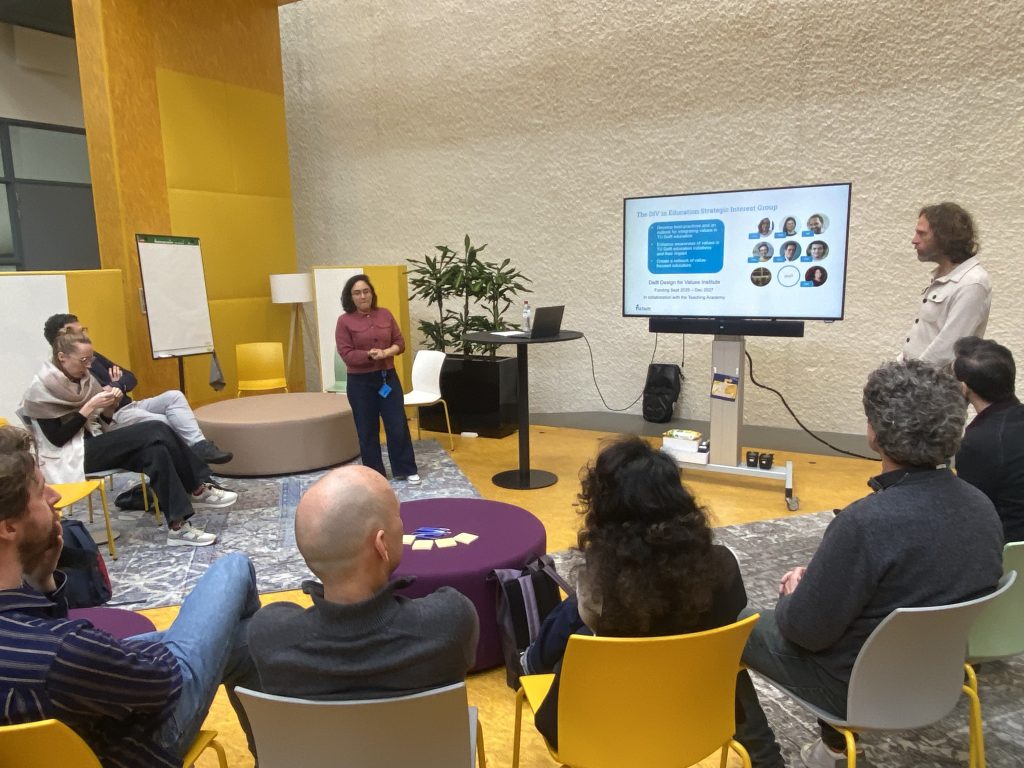
Design for Values in Education at TU Delft
The Education SIG aims to bring together educators from across the TU Delft to strengthen the integration of values, such as sustainability,…
 Apr 8
Apr 8
SIG Talks: Digital Technologies for Mental Well-being
As part of the Special Interest Group (SIG) on Digital Technologies for Mental Well-being, we highlight recent research exploring how ethical design…
 Feb 9
Feb 9
First 2026 Seminar of the Special Interest Group Design for Justice: A Pluralist Account
The Delft Design for Values Institute kicked off 2026 with the first seminar of its Special Interest Group Design for Justice: A…