
Embracing value conflicts and dynamics as key drivers for innovation

Reflections on the ‘Design for Values’ Dies symposium
By Pieter Vermaas (Philosophy Department of TU Delft, Executive Director of the Delft Design for Values Institute)
At January 10th of 2020 the TU Delft celebrated its 178th birthday on the Dies Natalis. This celebration consisted of a research symposium in the morning and a academic ceremony in the afternoon. This year the overarching theme was ‘design for values’. In the morning symposium we explored this theme with speakers from six faculties of the TU Delft. Paul Hekkert of the IDE faculty gave the Dies Lecture during the afternoon ceremony, and the honorary doctorates were bestowed upon Batya Friedman, University of Washington, and Marco Steinberg, Snowcone & Haystack, for their seminal work on using design for realizing and protecting our moral and societal values.
The Dies symposium was organised and moderated by the Delft Design for Values Institute. The symposium started with an introduction by Jeroen van den Hoven from the TPM faculty and Scientific Director of the Delft Design for Values Institute. What we mean with ‘design for values’ is making choices in design and technology development with explicit reference to and for reasons of moral and social values. Design for values means incorporating our moral and social values in the outcomes of our research and development; the technologies and designs that are developed should minimally protect these values or, even better, realise them. And we should incorporate these values in an explicit and directed way, based on articulated knowledge, methods, and practices. And that is where the institute comes in: we aim at that articulation.
Incorporating moral and social values in technology and designs may seem like matching the distant domains of ethics and engineering. Yet, incorporating values such as efficiency, safety and sustainability is already seen as an integral part of design in engineering, architecture and product development. The presentations by Stefan Aarninkhof (CEG) and David Abbink (3mE) showed that at TU Delft we are already capable to incorporate also other values in our designs. Coastal works around the world are designed to also serve societal values as recreation and economic activity. And in designs of the interaction between drivers and their future autonomous cars, values such as control and responsibility of the driver are incorporated.
Two of the challenges to overcome when engaging in designing for values – value dynamics and value conflict – were placed central at Dies symposium and were discussed with panels of speakers, including the honorary doctors.
Batya Friedman, who gave the first keynote, showed the potential of design for values for creating a world in which the lived life of persons is central and honoured. Being the driving force behind value-sensitive design, a design method that takes into account the values of individuals, she could draw from twenty years of experience in designing for values. With her starting point that in designing products we are designing, in a literal sense, ways of being for people, she analysed value dynamics in detail, in terms of changes in the meaning of values for individuals due to shifts in context. For instance, the values of privacy and maturation may imply that in general adolescents do not share their information on their smart phones with their parents. Yet in situations of emergency these values are subsided and the value of safety implies that information is being shared. By Batya’s analysis, the challenge of value dynamics is a challenge of designerly sensitivity to the context of people, and shift therein, and creating solutions that fit that context.
Three speakers from TU Delft reflected further on the challenge of value dynamics. Ibo van de Poel (TPM) identified technological development as a key driver of changes in values through the morally problematic situations that this development creates. For instance, the situation that social information technologies have created, has led to the current focus on the value of privacy. Maurice Harteveld (ABE) gave a detailed analysis of how architects design the urban environment for the values of freedom, justice and inclusivity in response to the emerging technologies of automated vehicles and applications of smart phones. Both speakers invited designers to anticipate value dynamics by thinking about the values we will hold important in future situations created by technologies. Roy Bendor (IDE), in contrast, called for not trying to control value dynamics, but embrace it as a phenomenon that shows that we are uncertain about that future. Designing can then be used for exploring and speculating about possible futures and for asking questions about how our values will play out in those futures.
Marco Steinberg focussed on the big global challenges of today in his keynote and argued that design should be used to create new realities and create the ways to transition to these realities. The institutions for governance that we have today, have been successful in bringing the current high living standards. But these institutions are less equipped to address our current global challenges or to let us adopt possible solutions. Changing the name of a Helsinki metro station took three years, cleaning the river Rhine took thirty years, which makes it implausible to assume that our current institutions will realise the Sustainable Development Goals in the remaining nine years that we have set ourselves. Design has the tools for addressing societal issues more swiftly, from prototyping urban areas with inhabitants out on the street, to developing strategies for Uruguay to use the construction of a new paper pulp plant to open up new directions for the country’s development.
Whereas the discussion on value dynamics yielded that designers have ways to deal with it, the three TU Delft speakers reflecting on value conflicts presented this second challenge as something that surfaces in design and for which engineering and architecture can use support. Marja Elsinga (ABE) introduced the one million homes initiative taken up by her faculty. Realising new housing in the Netherlands on such a large scale should be doable yet faces a conflict between the value of inclusiveness – providing housing to all – and values as sustainability and preserving nature. Doris van Halem (CEG) presented efforts to supplement current economic developmental efforts in Africa with projects to offer abundant fresh water. In engineering, these projects are assumed to have straightforward positive effects, yet research is needed to assess if they may also lead to value conflicts by shifting balances in the concerned regions. Alan Hanjalic (EEMCS) discussed recommender systems and the detrimental effects they have on society. These effects, such as the emergence of information bubbles, may be avoided by redesigning recommendation systems, yet this redesign will conflict with the values of free-market economics and with values of autonomy of citizens in information gathering. Addressing such conflicts seems to lie outside the domain of computer engineering, but then who will address them?
Taking stock, the two keynotes demonstrated the wide application spectrum of designing for values. Batya Friedman showed the relevance of design for values to the lived life of individuals. Marco Steinberg showed the relevance of design for values for dealing with our global challenges. The two themed discussions presented different kinds of routes for the Delft Design of Values Institute. For dealing with both value dynamics and value conflicts, further methodological tools can be developed to support design for values at TU Delft and elsewhere. The tools for designing for value dynamics can have different goals: creating designs that give shape to and anticipate the ways in which values may change over time; and creating designs that more speculatively explore possible futures. Here lie opportunities for research in the institute to enrich and diversify design for values. Developing the tools to work with value conflicts in turn gives opportunities for collaboration between researchers from different TU Delft faculties. Where designers have the knowledge and skills to explore the wider societal context and the impact of their designs on that context, collaboration with application domains is needed to develop tools to include societal and moral values in their work and in their designs and technology, and to address possible conflicts between them.
If you want to focus on these themes and work on the challenges of design for values, please contact us and join the Delft Design for Values Institute.
It was an experience to be involved in this Dies and to organize the symposium. The Management Team of the Delft Design for Value Institute was in charge for this event, with Linda Rindertsma in the lead and Nynke Tromp (IDE), Hessel Winsemius (CEG) and myself moderating the sessions.
Pictures, presentations and recordings of the Dies Natalis can be found here.
W2R2bWVtYmVyIGlkPSIyMTcyIiBncmlkc3R5bGU9ImZ1bGwiIG9mZnNldD0iMjAiIGl0ZW13aWR0aD0iMjUwIiBzaWRlPSJyaWdodCIgcm91bmRlZD0iIl0=
Related posts
 Apr 20
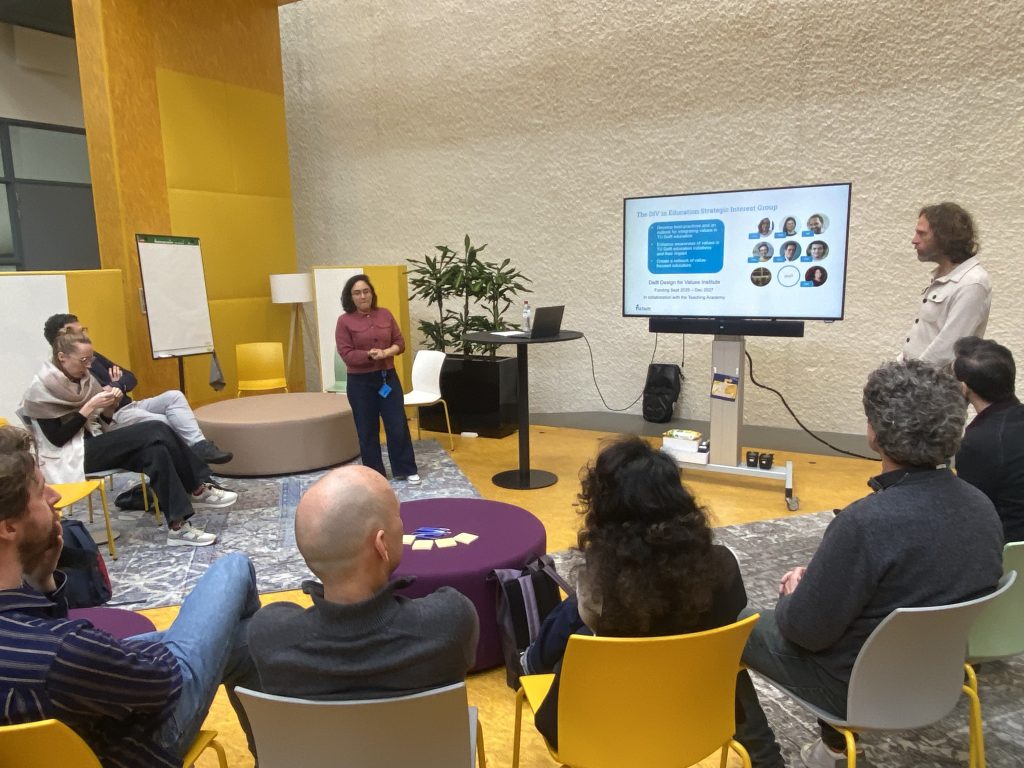
Design for Values in Education at TU Delft
The Education SIG aims to bring together educators from across the TU Delft to strengthen the integration of values, such as sustainability,…
 Apr 8
Apr 8
SIG Talks: Digital Technologies for Mental Well-being
As part of the Special Interest Group (SIG) on Digital Technologies for Mental Well-being, we highlight recent research exploring how ethical design…
 Feb 9
Feb 9
First 2026 Seminar of the Special Interest Group Design for Justice: A Pluralist Account
The Delft Design for Values Institute kicked off 2026 with the first seminar of its Special Interest Group Design for Justice: A…