
The Hague in the 21st Century; Responsible Innovation for Sustainable Peace, International Rule of Law and Global Justice

How does The Hague remain one of the most important cities in the world in the area of Peace, Law, Justice and Security in the 21st century? The Hague owes its international reputation to recognizing problems and solving them pragmatically in times of high political tension, arms races and rapid technological change in the beginning of the 20th century. The metropolitan region of The Hague is also internationally associated with the cradle of thinking about World Peace and the International Rule of Law, in the persons of Erasmus and Grotius, and with the roots of the early Enlightenment as represented by Spinoza and Bayle. In order to be able to play a similar role in the world in the 21st century, The Hague is now also facing with the challenge of understanding the nature of the problems of humanity and of offering solutions.
W2R2bWVtYmVyIGlkPSIyMTYyIiBncmlkc3R5bGU9ImZ1bGwiIG9mZnNldD0iMjAiIGl0ZW13aWR0aD0iMjUwIiBzaWRlPSJyaWdodCIgcm91bmRlZD0iIl0=
The intellectual climate in The Hague around 1900 pointed towards a ‘World Capital’. Competition with other cities was in full swing in this area. Perhaps the most important explanation for the success of The Hague is that it succeeded in placing an important issue on the global agenda of mankind at the end of the second millennium, instead of striving for excellence on agendas proposed by others. The ideas of World Peace, International Rule of Law and institutionalization of Arbitration were invented here.
More than a century after the second peace conference in 1907, the world looks radically different in the 21st century. Complex humanitarian, sustainability and security issues on the world stage are immediately tangible at local levels. This world is complex, hyper-connected, dynamic and unstable. Social media and mobile internet bring great benefits, but also come with many new vulnerabilities.
The international community has drawn up a consolidated list of 17 Sustainable Development Goals (SDGs), similar to the international consensus regarding the so-called Grand Challenges and the Millennium Goals. This list of problems will strongly determine the global debate on a safer and more just world in the remainder of the 21st century.
New in this context is the importance accorded by the UN to the role of innovation, technology and applied scientific research with a strong multidisciplinary character. It is clear that no progress can be made on solutions to these problems if it is not recognized that technology is both part of the problem and can also be part of the solution. For this reason, the UN has set up a Technology Facilitation Mechanism (TFM) to promote innovative solutions on the SDG agenda. This is an important development within the UN, which for the first time explicitly focuses on perhaps the most important driver of the history of the 21st century: technology.
We cannot afford such mistakes
An important aspect of the SDG agenda is that the problems cannot be treated in isolation, but must be viewed in conjunction. Meanwhile there are decision-making tools that help to understand, model and visualize the interrelationships between the SDGs. Because it is not a list of separate problems, the situation is complex and so are interventions and policy measures. Another aspect associated with these mutual relationships is the fact that the complexity with which we are confronted requires a new multidisciplinary science that allows us to understand connections and to deal with these problems on a global scale.
To gain a better understanding of complex adaptive systems, multidisciplinary centers for complexity science have been set up in numerous places. In these centers, scientists from different disciplines work together on models and simulations to improve our understanding complex systems in order to better predict their behavior. On the basis of these models, policy makers arrive at more adequate and responsible interventions that result in improved policies.
The outcomes of this type of research are often counter-intuitive for policy makers and politicians. Our interventions in social, economic and ecological systems often have unexpected negative consequences. We can, however, not afford such mistakes in combating climate change, humanitarian and economic crises, cyber war and terrorism. Such missteps can be prevented by using new approaches to science that leads to more insight into complex phenomena as a basis for policy.
The new sciences, innovation and technology are necessary to create conditions for achieving the moral objectives that have been specified in the SDGs. The new science, knowledge and expertise are morally blind without normative frameworks, but normative principles without the ability to intervene are impotent. The SDGs absolutely require responsible innovations: innovations that adequately realize the moral ideals of peace, justice and justice and other shared moral values.
Go digital or nowhere
The traditional subjects of The Hague will therefore have to take a central place in the work on the SDG agenda: without International Law, peace building, diplomacy, humanitarian aid and development cooperation, protection of human rights, promotion of security, fighting corruption, fraud, organized crime and terrorism, applied science and innovation will miss their desired effects. The traditional disciplines in The Hague will have to play a role in this new world and must connect with other new scientific knowledge and technology.
Moreover, in the coming decades, the disciplines of The Hague will also have to make use of new, mainly digital, technology for the development of their own instruments, methods and techniques. Professionals in the fields of law, diplomacy, policy, international relations will have to go digital or nowhere. The Hague could provide expertise that prepares for this new role of international law and innovations within it.
The Netherlands has received international recognition for its approach to innovation. A “Dutch Approach” has become visible. This approach can be extended in different ways through good cooperation in The Hague through a range of triple helix mechanisms. Such an approach is desperately needed in the areas of cyber security, transport and logistics, robotics, energy transition, self-driving cars, industry 4.0, Internet of Things, block-chain, waste processing, circular economy, urban planning, smart city development, fintech and finance, data science and humanitarian aid and development cooperation.
In addition to its practical and efficient approach, The Hague has the most official offices of Dutch universities within its city limits and, according to a ranking of the Times, it is one of the top academic cities in the world. The universities within the proposed partnership can jointly perform applied and fundamental research that supports the plans for The Hague’s International Agenda, the SDG agenda and the Digital International Legal Order that we will have to work on in the remainder of this century.
The city of The Hague and the Dutch government want The Hague to maintain its position as UN city and international city of Peace and Justice in the 21st century. They also want the Netherlands to continue to play a meaningful role on an increasingly dynamic and chaotic world stage. In order to perpetuate the special position in the world, it is now no longer sufficient to build on the achievements of the past along paved roads. In short, in the coming years in and around The Hague we need to give a 21st century meaning to the theme of Peace and Justice, partly through technological innovations and digitization.
This is a summary of an essay that Jeroen van den Hoven wrote for the municipality of The Hague, as part of a pilot for a research program on responsible innovation and the SDGs.
Related posts
 Apr 20
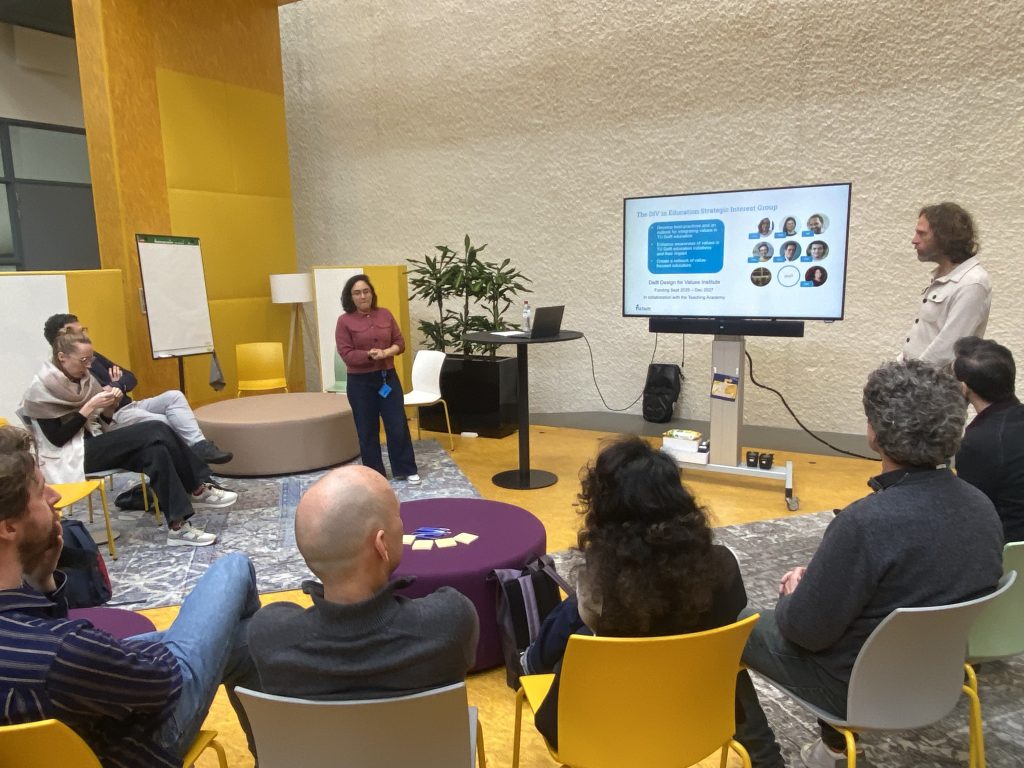
Design for Values in Education at TU Delft
The Education SIG aims to bring together educators from across the TU Delft to strengthen the integration of values, such as sustainability,…
 Apr 8
Apr 8
SIG Talks: Digital Technologies for Mental Well-being
As part of the Special Interest Group (SIG) on Digital Technologies for Mental Well-being, we highlight recent research exploring how ethical design…
 Feb 9
Feb 9
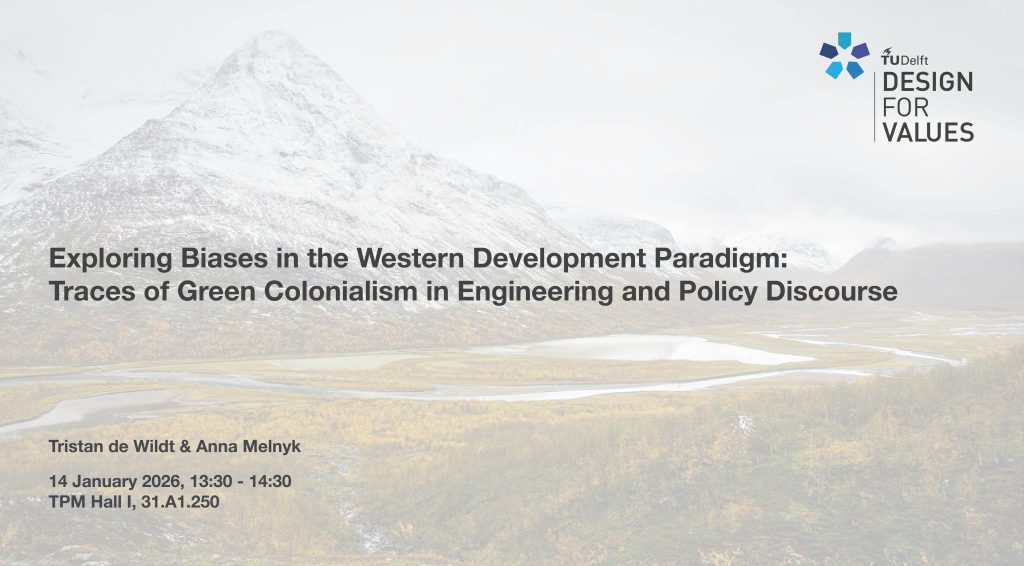
First 2026 Seminar of the Special Interest Group Design for Justice: A Pluralist Account
The Delft Design for Values Institute kicked off 2026 with the first seminar of its Special Interest Group Design for Justice: A…