
How to Win Elections in the 21st Century… and How to Save Democracy

According to the American Pragmatist philosopher John Dewey we have to reinvent democracy every day anew… and now, in the age of big data and artificial intelligence, in addition we have to design for it, every day. If we cannot design against undemocratic tendencies and technically implement our democratic ideals and ideas, Jeroen van den Hoven and Haye Hazenberg argue, we risk losing them altogether.
A talk given by Jeroen van den Hoven at a workshop at the European Parliament, “How to win Elections: Reflections on the use and misuse of technology in electoral campaigns” (7 November 2018). The talk was prepared together with Haye Hazenberg.
How to win elections in the 21st century? I’m afraid I am fairly pessimistic when we look at the most promising answers to that question. This is the reason why a number of concerned colleagues in Europe published a paper in Scientific American early 2017 with the title “Will Democracy survive Big Data and AI?”. Recently, Delft University of Technology carried out a study into the manipulation of voters during the local elections in The Netherlands in spring 2018. Considerations here are based both on the views formulated in the Scientific American paper and on the empirical findings of the Delft study and a forthcoming publication with Delft colleagues based on it.
I think the picture is pretty clear by now. Those who are willing and capable to invest in social media strategies, engage in micro-targeting, psychological profiling and psychography, nudging, machine learning, those willing to mobilize bot nets, launch large volumes of fake Facebook and Twitter accounts, sending AI powered messages, while using Big Data collated from user generated data and massive A/B testing, those deploying recommender systems, managing Youtube Channels: those people can achieve a lot. There is a self-reinforcing Bermuda triangle in place that consists of advanced behavioral science (choice modelling, study of cognitive biases, nudging techniques) machine learning and Big Data. It devours human autonomy and self-determination. And what is even worse: it is for sale, as the Cambridge Analytica case has demonstrated. New investigations of foreign money streams and manipulative practices associated with the Brexit campaign in the UK are under investigation.
The return on investment of learning about the probabilities of winners and losers in elections or referenda can be high. Being in a position to determine the outcomes of these processes with near certainty is of course priceless.
Political investors can exploit the fact that we have introduced vulnerabilities into western liberal democracies by naively assuming over the last three decades that the invisible digital hand would by itself produce a good and democratic digital society. This turns out to have been a fatal mistake.
This I believe has been a motor of our contemporary epistemic crisis. The crisis of a jeopardized pursuit of truth. Our former truth tracking institutions are no longer fully truth oriented. Merchants of doubt have tainted science with anomalies and flawed statistics, influencers and meddlers have compromised independent journalism with fake news, propaganda, disinformation and false hyper-partisan narratives. Lobbyist have undermined trust in politics. Profit maximizing managing elites have obliterated trust in the financial sector and the corporate world. And digital technologies have given a helping hand to all of them.
The Top Legal advisor of the European Commission Paul Nemitz discusses the enormous concentration of power with BigTech in a recent publication. He draws attention to a very unfavorable constellation that threatens our open liberal democracies: accumulation of capital, ownership of ubiquitous and central digital infrastructures and online platforms, the domination of public discourse and journalism, the control over persons and their data, and finally monopolies in AI science, technology and innovation.
In order to protect and strengthen Western Liberal democracies in the Age of AI and the core trinitarian idea of ‘human rights, rule of law and democracy’, Nemitz argues, we need “ a new culture of technology and business development …which we call human rights, rule of law and democracy by design”. I will come back to this suggestion concerning design, since I think it is our only hope left.
Trust in the institutions of liberal-democracy is in decline all over the world (Annual Report of the Varieties of Democracy Institute 2018; Democracy Index of the Economist Intelligence Unit 2017; Foa and Mounk 2017), while independent media, freedom of expression and alternative sources of information are among the democratic parameters that have shown the greatest global decline in recent years.
Some countries in Europe have successfully offered resistance to these trends while at the same time adopting digital technologies. In the Netherlands, for example, trust in the media is very high, while citizen concern regarding disinformation is extremely low, and the percentage of citizens that have reported to come into contact with disinformation is with 10% the second lowest globally (de Cock Buning, Eljon, and Bune 2018; Fletcher 2018; Commissariaat voor de Media 2018).
So what are the main threats?
The first potential threat concerns the rise of political micro-targeting, which allows political actors to target individual citizens directly in their online browsing, so that every user gets a different, specifically tailored advertisement to see. This tailored advertising model comes with the digital economy and the features of the current online platform environment. But it is potentially disastrous for democratic politics when political advertisements remain in the ‘dark’, or are unknowable to anyone except the sender, receiver, and the digital platform intermediary. At that point, customized political advertisements erode the public dimension of democratic politics. Different political actors should be able to contest one another’s ideas in public.
The second problem is that the rise of a ‘new online public space’ can be harmful when the ‘old’ shared public space is left vacant, or when it leads to further ‘filter bubble’ divisions and balkanization. Citizens may focus on a private online world whereas a public sphere withers away. This gives a completely new meaning to Habermas’ structural change of the public sphere.
A third harm can come from disinformation, which is intentionally misleading information, provided for political purposes and gain. A fourth related harm might come from ‘algorithmic distortion’, where the selection of content by algorithms online might enhance political filter bubble divisions and echo chambers.
The Dutch experience in local elections of 2018
Our study of manipulation of voters online during the local elections in The Netherlands shows that political micro-targeting is both possible and probable – even in the Dutch parliamentary system. On the basis of surveying trackers on Dutch political news sites, personal political blogs, and the websites of all major political parties, we found Google and Facebook trackers most present, together with a host of relatively small data analytic companies that provide personal and categorical advertising capabilities. Some firms also provide tailored big data political micro-targeting capabilities, and between 70 and 80 political parties have made use of these services (Bouwman 2018). And while we found that political parties do not themselves engage in large-scale micro-targeting through the use of trackers on their websites, all parties admitted to making use of Facebook’s micro-targeting platform for political campaign advertisements.
While many accounts on Twitter are controlled by human users, many others are partially or highly automated (bots). The ‘botometer’ API (IUNI 2018) we used, provides estimates of the likelihood of automation for each account in our data set. We found that the right-wing party of Geert Wilders – the PVV – benefited most from engagement by accounts that were deleted immediately after the election (which is evidence of bot activity), and that other right-wing parties also benefited more from such engagement than other parties.
Accounts associated with the far-right party of Geert Wilders had the most interactions with all echo chambers we identified. This seems to suggest that Wilders supporters determine large parts of the narrative on Twitter, employing a ‘hegemonic discourse’. Targeting the discourses affiliated with populist far-right would therefore make a lot of strategic sense for Russian trollers when seeking to influence the views of all parties.
When searching for Dutch political content on Youtube, one is three times more likely to encounter ‘populist far-right’ content than that of any other political ideology. Regarding Twitter, we found that for new Twitter profiles, the suggestions offered by the Twitter algorithm when expressing one’s interest in ‘Politics’ lean almost exclusively to right-wing populism. When asked for explanation, Twitter responded that this reflected the state of Dutch twitter discourse. Nonetheless, even as this would provide proof of the ‘neutrality’ of the algorithm – as it merely reflects actual discourse – a right-wing populist bias is still present for those citizens entering the platform without any preference. We have shown this to be true in particular for Youtube.
The digital environment thus did delegitimize the Dutch elections in the sense that the use of nontransparent and potentially illegal micro-targeting was used by all parties. There is also a strong rise in intermediary companies and trackers, which means that there is an increasing power of corporate actors in public affairs. The conservative right-wing discourse that was hegemonic online moreover proved particularly vulnerable to potential disinformation through bot engagement.
This is in line with the findings of Yochai Benkler’s recent study about Network Propaganda and Radicalization in American Politics, which finds not a symmetric polarization, but rather an asymmetric radicalization, with much more prominence on the extreme right-hand side of the political spectrum. Benkler’s analysis suggests that in the American case it is not simply Facebook, the Russians and the algorithms that are to blame, but there is a gradual chance over 4 decades in American political life.
Design for Democracy, Design for Values
What can be said I think globally is that in the age of ubiquitous digital technology our values, ideals and principles need to be designed for. One could even argue that talking about responsibility, privacy, autonomy, safety and security without providing ideas about their anchoring in a digital world is gratuitous. If we do not think about design ourselves in a transparent and accountable way, others will do it in self-serving ways, surreptitiously. According to the American Pragmatist philosopher John Dewey: we have to reinvent democracy every day anew… and now in addition we have to design for it, every day. If we cannot design against undemocratic tendencies and technically implement our democratic ideals and ideas, we risk losing them altogether.
Fortunately, there are many experiments underway with design for diversity, design for participation, design for inclusion, and software that breaks filter bubbles. One needs to proceed carefully though as recent studies have demonstrated that these attempts to open filter bubbles may sometimes have the opposite effects and lead to polarization instead of reconciliation.
An interesting fundamental design along this line is Tim Berners Lee’s plan for self-sovereign identity management infrastructure[note]See https://solid.inrupt.com/ and https://www.inrupt.com/ [/note]. This is very important for the future of privacy and data protection
Experiments with forms of deliberative platforms are also underway. Delft is building massive open online deliberation platforms. Not MOOCs but MOODs. We have experimented in Rotterdam in the Netherlands with limited functionality supporting 1000 citizens involved in a one-day deliberation about issues on the political agenda of the city.
The European Commission and the European Parliament urgently need to embark upon a large pan European Design for Online Democracy initiative, before it is too late.
W2R2bWVtYmVyIGlkPSIyMTYyIiBncmlkc3R5bGU9ImZ1bGwiIG9mZnNldD0iMjAiIGl0ZW13aWR0aD0iMjUwIiBzaWRlPSJyaWdodCIgcm91bmRlZD0iIl0=W2R2bWVtYmVyIGlkPSIzMDY2IiBncmlkc3R5bGU9ImZ1bGwiIG9mZnNldD0iMjAiIGl0ZW13aWR0aD0iMjUwIiBzaWRlPSJyaWdodCIgcm91bmRlZD0iIl0=
Recording of this talk:
You may also be interested in:
Related posts
 Apr 20
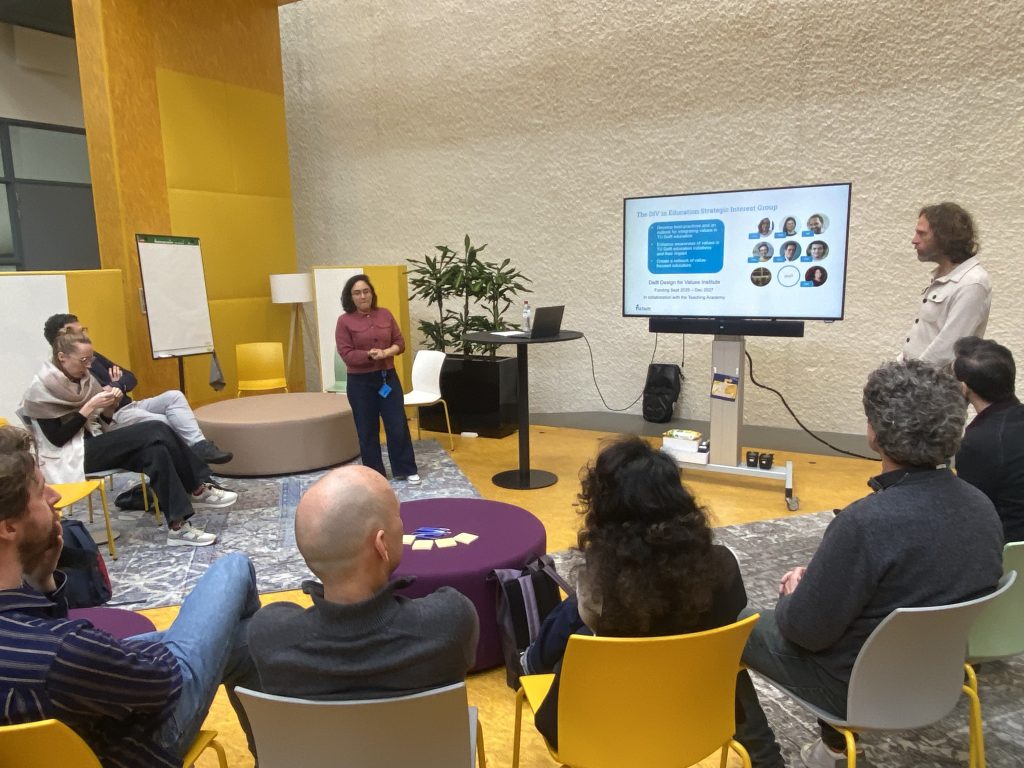
Design for Values in Education at TU Delft
The Education SIG aims to bring together educators from across the TU Delft to strengthen the integration of values, such as sustainability,…
 Apr 8
Apr 8
SIG Talks: Digital Technologies for Mental Well-being
As part of the Special Interest Group (SIG) on Digital Technologies for Mental Well-being, we highlight recent research exploring how ethical design…
 Feb 9
Feb 9
First 2026 Seminar of the Special Interest Group Design for Justice: A Pluralist Account
The Delft Design for Values Institute kicked off 2026 with the first seminar of its Special Interest Group Design for Justice: A…